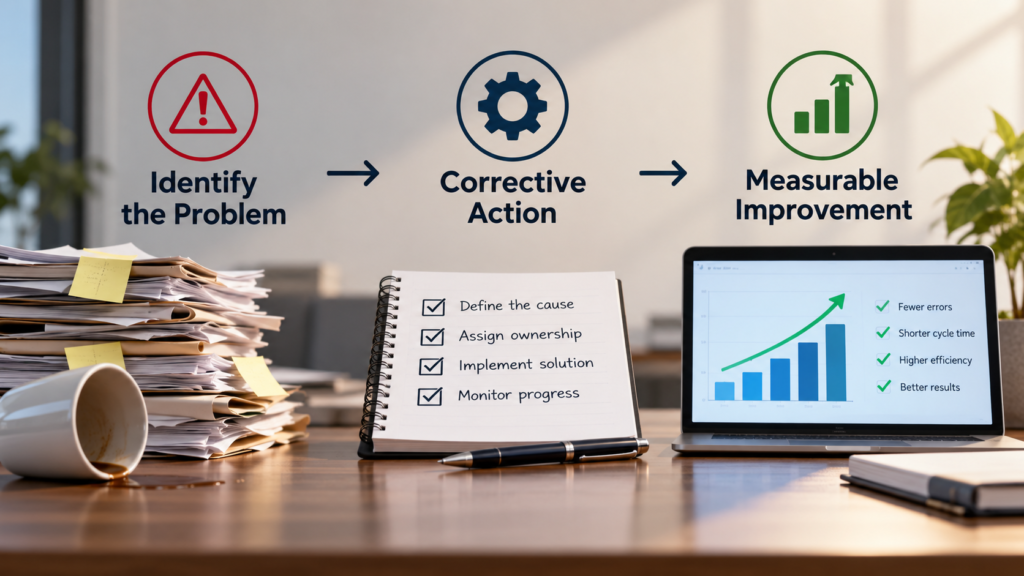
Knowing the Problem
Organizations often know where their problems are.
Leaders know when workloads are uneven. Employees know which processes create unnecessary delays. Customers know where service breaks down. Managers may already recognize recurring staffing problems, communication gaps, duplicated work, or responsibilities that are not clearly assigned.
The challenge is not always identifying the problem.
The challenge is turning what the organization knows into corrective action.
Recognition Without Action
A problem can become so familiar that an organization learns to operate around it instead of correcting it.
Employees develop workarounds. Managers compensate for weaknesses. Additional meetings are scheduled. Spreadsheets are created to track information that existing systems should already provide. One employee begins performing tasks that properly belong somewhere else.
Eventually, the workaround becomes part of the operation.
That can make an organization appear functional while the underlying problem continues to consume time, money, and capacity.
Define the Actual Problem
Before implementing a solution, determine what is actually causing the problem.
A staffing problem may really be a scheduling problem.
A performance problem may actually be unclear expectations or inadequate training.
A communication problem may be caused by poorly defined decision-making authority.
A capacity problem may be the result of inefficient workflow rather than insufficient personnel.
Treating the symptom instead of the cause can create additional work without improving performance.
Good. Now add the next section:
Assign Ownership
Corrective action needs an owner.
Someone should be responsible for moving the issue from identification through resolution. That does not mean one person must perform every task. It means someone is accountable for coordinating the work, monitoring progress, addressing barriers, and reporting whether the corrective action is producing the intended result.
Without ownership, problems can remain everyone’s concern and no one’s responsibility.
Establish a Measurable Result
“Improve communication” is difficult to measure.
“Reduce unanswered customer inquiries,” “shorten approval time,” “eliminate duplicate data entry,” or “reduce scheduling errors” provides something that can actually be evaluated.
The organization should know what improvement will look like before implementing the solution.
Test Before Expanding
Not every corrective action needs to be implemented across the entire organization immediately.
A change can often be tested within one team, program, location, or process. The organization can then evaluate the results, identify unintended consequences, make adjustments, and determine whether the change should be expanded.
A controlled test can prevent a reasonable idea from becoming an organization-wide problem.
Make the Improvement Part of the Operation
A successful corrective action should not depend permanently on extraordinary effort.
If the improvement works, it should eventually become part of the normal operation through documented procedures, assigned responsibilities, appropriate training, performance measures, and management oversight.
Otherwise, the organization may gradually return to the same problem it believed it had solved.
The Management Question
Identifying problems is important. But organizations improve when leaders create a disciplined process for doing something about them.
When a recurring problem is identified, ask:
Who owns the corrective action, what result are we trying to achieve, and how will we know when the problem has actually been resolved?