A strong mission can create pressure to grow quickly. An organization sees increasing demand, identifies an unmet need, or receives an opportunity to serve more people. The natural response is to expand.
But before increasing volume, there is another question worth asking: Can the current operation carry the additional work without reducing quality?
Growth Can Outpace the Systems Supporting It
Organizations rarely struggle because they care too much about growth. Problems occur when growth moves faster than the systems supporting it. As volume increases, small weaknesses can become larger operational problems—follow-up becomes inconsistent, documentation falls behind, reporting becomes more difficult, deadlines are missed, and staff begin carrying more work than the process was designed to handle.
Start With the Current Workload
Before expanding, document everything required to move one participant, case, referral, or customer through the current process. Do not look only at the visible service. Include the administrative work that makes the service possible.
That may include outreach, eligibility, intake, documentation, scheduling, orientation, service delivery, follow-up, data entry, and reporting. Once the complete workload is visible, leadership can begin determining whether the existing operation has enough capacity to handle additional volume.
Clarify Ownership at Every Stage
A process becomes vulnerable when responsibility is unclear. At every stage, leadership should know who completes the step, who makes decisions when the normal process does not apply, who receives the work next, and who confirms that the handoff actually occurred.
There should also be clear responsibility for following up when work stops moving. Growth magnifies unclear ownership, so these responsibilities should be established before additional volume enters the system.
Find the Bottleneck Before You Add Volume
Every operation has a point where work is most likely to collect or wait. Before expanding, identify that bottleneck and determine what is causing the delay. Then ask what happens at that point if the volume of participants, referrals, cases, or customers increases.
The solution may involve staffing, scheduling, decision rules, better information, or changes to the workflow. The answer is not always simply adding more people. Identifying the actual constraint first helps an organization invest its resources where they will have the greatest operational impact.
Measure What Helps You Make Decisions
An organization does not need dozens of measures to understand whether an operation is ready to grow. Start with a small set of measures that help leadership identify where action may be needed.
Useful measures can include the number of new requests, referrals, or participants; the time required to reach the next meaningful step; how much work is waiting and how long it has waited; completion or service-delivery rates; the reasons work stalls; and available capacity at the bottleneck. A useful measure should help someone make a decision—not simply create another report.
Test the Process Before You Scale
Before a full expansion, test the process with a smaller group. A limited pilot can reveal problems that may not be obvious during planning, including unclear roles, missing information, weak handoffs, steps that depend too heavily on memory, and unexpected delays.
Run the process, gather feedback from the staff involved, identify where the workflow breaks down, and make the necessary adjustments before increasing volume. A controlled test gives the organization an opportunity to correct problems while they are still manageable.
Address Problems Before Growth
When a pilot reveals a weakness, correct it before adding more volume. The adjustment may involve staffing, scheduling, decision rules, better information, or changes to the workflow.
Fix the constraint first. Then determine whether additional resources are actually needed. This approach helps prevent an organization from adding cost without addressing the underlying operational problem.
Readiness Protects the Mission
An operational-readiness review is not an argument against growth. It is a way to make sure growth does not undermine the very mission the organization is trying to advance.
A thoughtful readiness review helps protect the people being served, the staff doing the work, service quality, the organization’s reputation, and ultimately the mission itself. Sustainable growth happens when the operation is ready to support it.
Build the Operation Before You Build the Volume
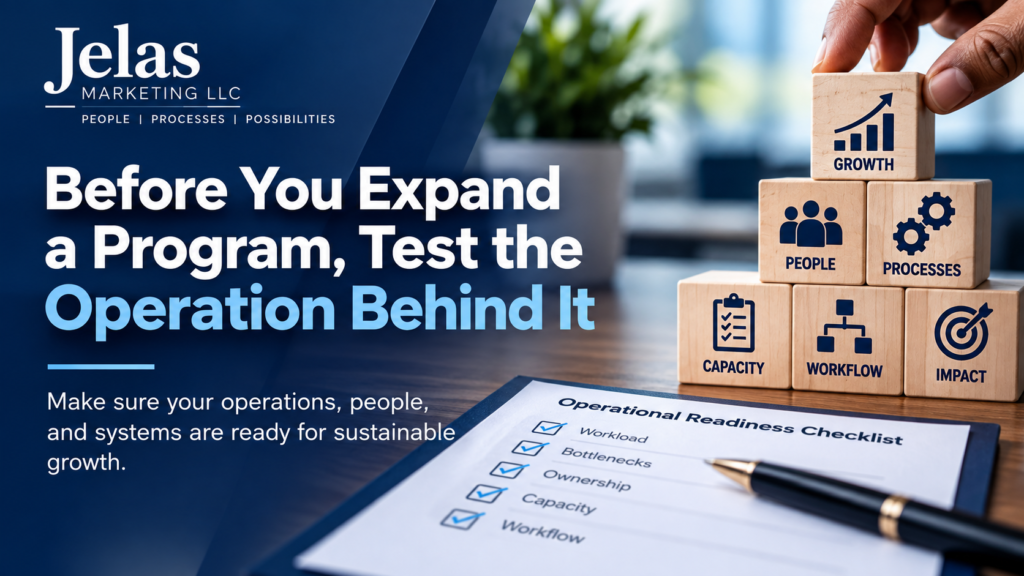
Growth should strengthen the mission—not strain the operation behind it. Before expanding, organizations should understand the workload, establish clear ownership, identify constraints, measure what matters, and test the process under controlled conditions.
When the operation is ready, growth can become a positive and sustainable step forward.