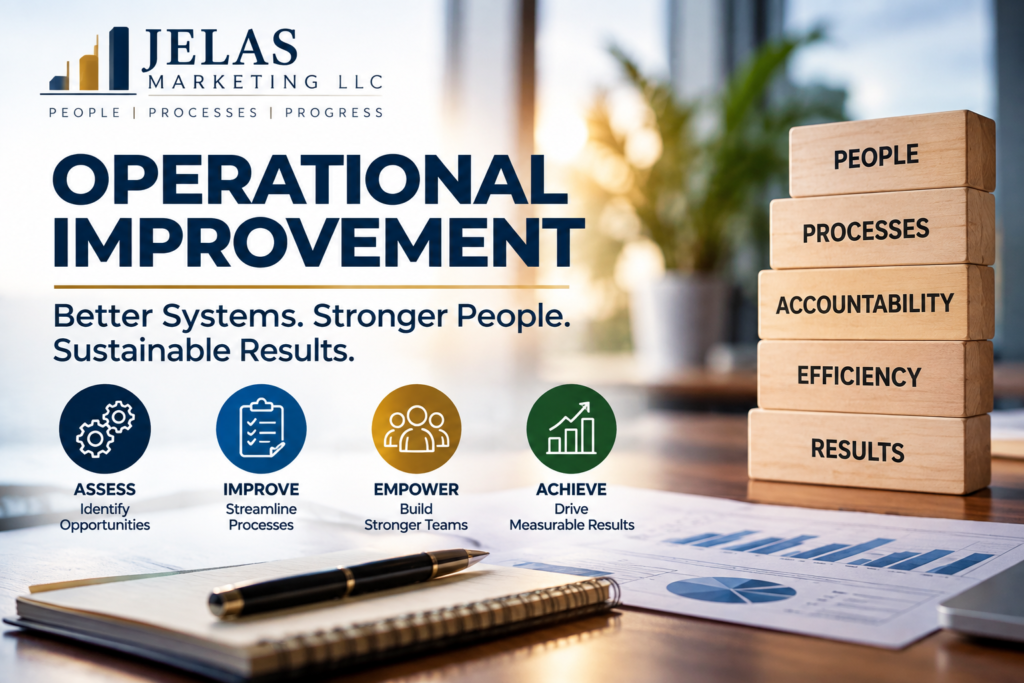
Operational improvement begins with a simple question: Is poor performance really a people problem, or are good people being asked to work within systems that make success unnecessarily difficult?
When organizational performance declines, leaders often respond by increasing supervision, adding training, rewriting expectations, or replacing employees. Sometimes those actions are necessary. But sometimes the people are not the primary problem.
A capable employee working within an inefficient process will eventually struggle. A strong manager operating without reliable information will make decisions with incomplete data. And a committed team working with unclear responsibilities, duplicated processes, inconsistent procedures, or poor communication will have difficulty producing consistent results.
Before concluding that an organization has a workforce problem, leadership should examine how the work itself is designed.
Look at the Process
Organizations develop processes over time. Some are intentionally designed. Others simply evolve. A step gets added because something went wrong. A spreadsheet is created to solve an immediate problem. Another person begins reviewing work because errors occurred. A new reporting requirement is added, but an old one is never eliminated.
Eventually, employees may spend significant amounts of time managing the process rather than accomplishing the mission.
Effective operational improvement requires leaders to examine what is actually happening. Ask: What is supposed to happen? What actually happens? Where does work slow down? Where are decisions delayed? Where is information entered or reviewed more than once? Who is responsible for each step? What information does management need to determine whether the process is working?
Those questions can reveal problems that additional training alone will never solve.
Clarify Accountability
Employees perform better when they understand what they are responsible for, what decisions they have authority to make, and when an issue needs to be escalated.
When responsibilities overlap—or when no one clearly owns an outcome—organizations often experience delays, inconsistent decisions, duplicated work, and frustration.
Accountability is not simply holding someone responsible when something goes wrong. Effective accountability begins by giving people clear responsibilities, appropriate authority, measurable expectations, and the information and resources necessary to perform successfully.
Measure What Matters
Organizations can collect enormous amounts of data without gaining useful information. Reports, spreadsheets, dashboards, and performance measures only create value when they help leadership understand what is happening and make better decisions.
Effective operational improvement identifies a limited number of meaningful measures that show whether the organization is achieving its objectives. Those measures should help leaders identify problems early, understand why they are occurring, and determine where corrective action is needed.
The purpose of measurement should not be to create another report. It should be to turn information into better decisions and stronger organizational performance.
Improve the System and Develop the People
Operational improvement and workforce development should reinforce each other. Better systems allow capable employees to perform at a higher level, while well-developed employees are often the people best positioned to identify where systems can be improved.
Leaders have a responsibility to create an environment in which both can happen. That means providing employees with the training and support they need while also examining whether organizational processes, policies, technology, communication, and management practices are helping or hindering performance.
Before assuming poor performance means you have the wrong people, examine the environment in which those people are being asked to succeed.
Sometimes the greatest improvement does not come from changing the workforce. It comes from changing the way the work gets done.